
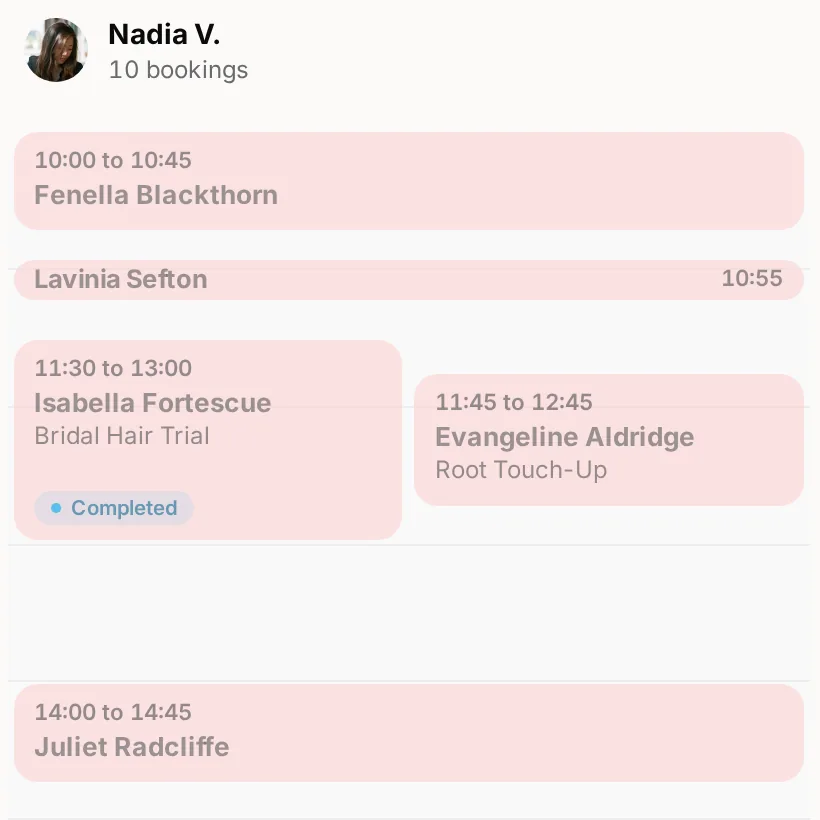
The gap a cancellation leaves
An hour given back at nine at night is still sellable in the morning, but only if somebody is asked while you are asleep.
A cancellation at nine at night offers itself to the next person on the list, with a fifteen minute window to take it, while you are asleep.
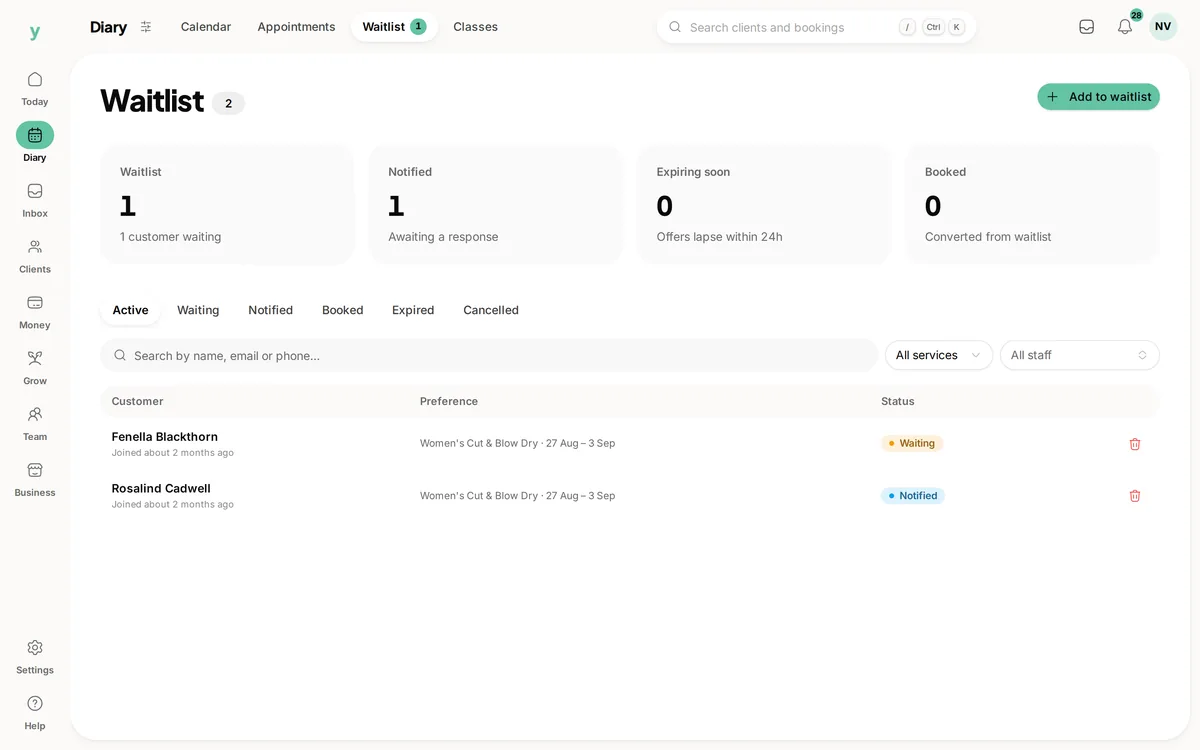
Real screens from The Cutting Room, our demo salon, with the numbers it shows today.
An hour given back at nine at night is still sellable in the morning, but only if somebody is asked while you are asleep.
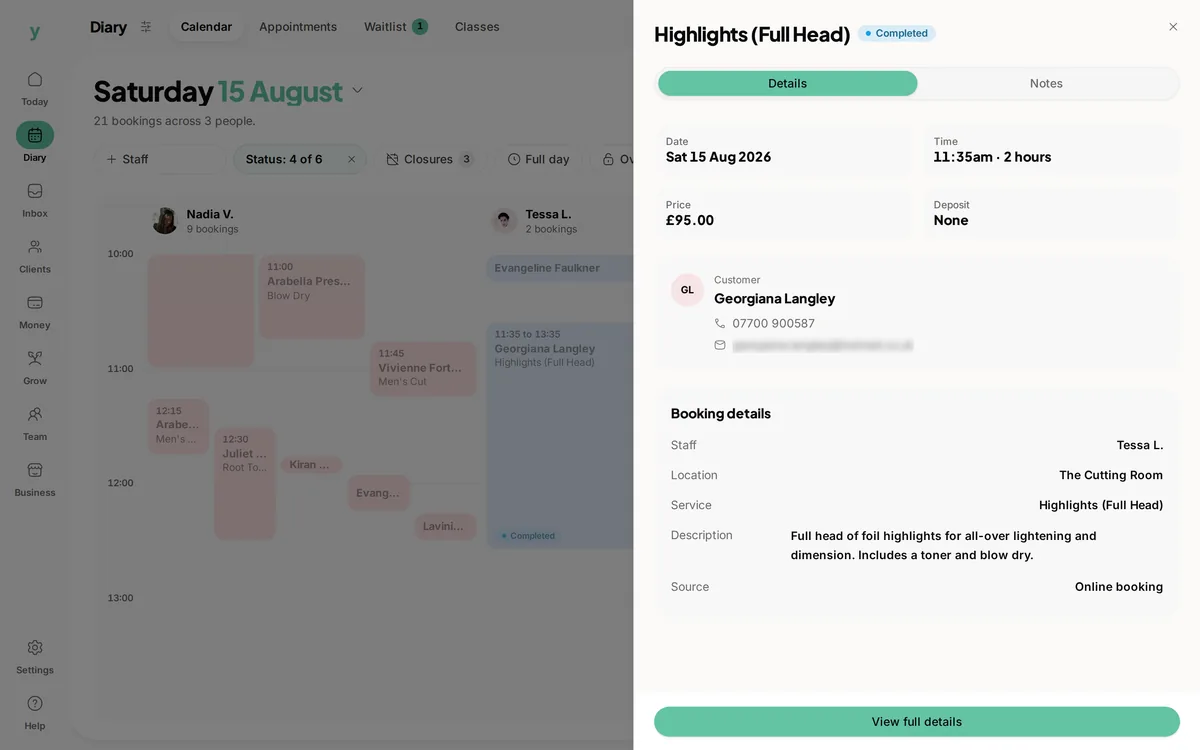 21 bookings across 3 people
An offer taken from the link writes a normal appointment into the diary, with the same price and the same rules.
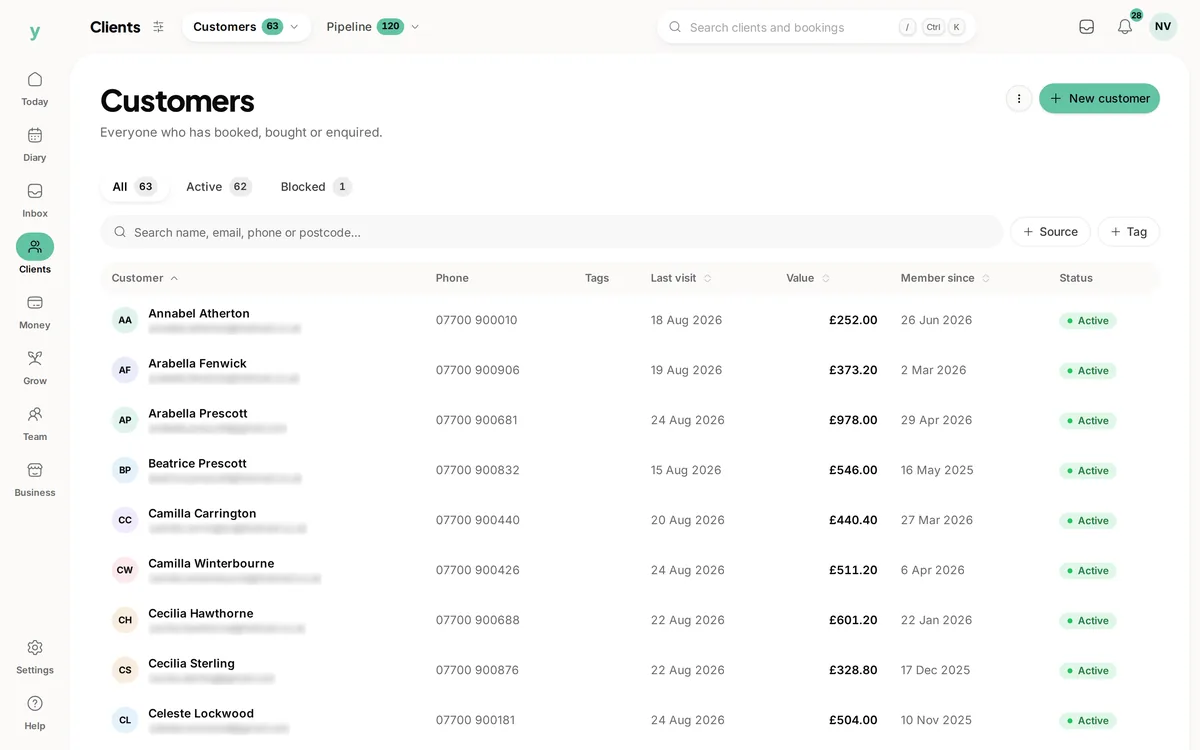 Last visit, value and status
A waitlist entry sits on the client record rather than on a note by the till, so nobody is forgotten twice.
A waitlist that you have to work is not a waitlist, it is a list. Somebody cancels at nine in the evening, you see it at eight the next morning, and by then you are ringing round people who have already made other plans for a slot in four hours. The value is entirely in what happens automatically in those eleven hours. This page is about how that works in Youzse, in what order and what the limits are.
A customer who wants a time you have not got can join the waitlist from the booking page itself, rather than sending you a message you then have to keep somewhere. Your own team can add somebody too, from the appointment or from the customer record, for the person who rings up.
They are not just joining a queue. An entry can carry the service, the member of staff, the location and a window of dates and times that would actually work: weekday evenings, the following fortnight, Saturdays only. A slot is offered to somebody it suits rather than to whoever happened to ask first.
An entry can also carry an expiry, so a request from three months ago does not get offered a slot the customer has long since stopped wanting.
A cancellation frees a specific service, person, place and time. The waitlist is matched against exactly that: somebody waiting on that appointment first, then somebody waiting on the service with that person or with anybody, whose date window covers the day.
One person is offered the slot, not everybody. They get a message with a link that is theirs alone, and fifteen minutes to use it. If they do not, the offer moves on.
Offering one person at a time is the part worth understanding, because it is a real trade. A free-for-all fills a slot faster and loses you the four people who clicked second and found it gone. One offer at a time, on a short clock, means the slot is still filled overnight and nobody is told they were too slow.
| On the entry | What it changes |
|---|---|
| Service | Only slots for that service are offered. |
| Member of staff | Pinned to one person, or left open so any of them counts. |
| Location | Relevant where you work from more than one place. |
| Date window | A start and end date the customer could actually attend between. |
| Time window | Evenings only, mornings only, whatever they said. |
| Priority | Who gets offered first when more than one entry matches. |
| Expiry | When the entry stops being offered anything at all. |
A class is where waitlists earn the most, because the cap is hard and the cancellations arrive late. Twelve machines means twelve people, and the thirteenth has to be told no.
A class session keeps its own list, and somebody who joins it is told they are on it rather than left wondering whether their booking worked. When a place opens the same offer mechanics apply.
If classes are most of what you sell, read the class packages page as well, because the pass somebody is holding and the place they want are two halves of the same problem.
A waitlist fills a slot somebody gave back. It cannot create one, and that is the distinction worth being honest about before you set one up expecting it to solve a different problem.
If your list is permanently twenty deep and your diary never has a gap, the waitlist is not an opportunity, it is a measurement. It is telling you that you are short of hours or underpriced, and the answer is more capacity or higher prices rather than a longer list. A list that never gets offered anything teaches people to stop joining it.
The other case it does not cover is the gap you can see coming: a Tuesday afternoon that is simply empty, with nothing cancelled and nobody waiting. Nothing is offered because nothing was freed. That is a demand problem rather than a matching problem, and filling it is a different piece of work.
Where a waitlist earns its keep is the middle case, which is most businesses: a diary that is mostly full with cancellations arriving at awkward hours. Those are the slots that quietly cost you a fortune, because they are already paid for in rent and wages whether somebody sits in them or not.
Among the entries that match, the one with the highest priority is offered the slot, and where two entries sit at the same priority the one that joined first wins. Everybody starts at the same priority, so left alone the list behaves as a queue.
Priority is there for the cases where a queue is the wrong answer: the client who has been waiting a month, the customer whose appointment you had to move, the person who is owed a favour. Raising one entry does not reshuffle the rest.
What the matching will not do is guess. It offers slots for the service on the entry, with the person named on it or anybody if none was named, inside the date window the customer gave. A customer waiting for a colour is not offered a cut because the gap happened to be the right length.
A waitlist is also the most honest demand signal a service business has. It is the only record of the work people tried to give you and could not.
Your dashboard can carry four figures from it: how many are waiting, how many have an offer out, how many of those offers turned into bookings and how many entries are about to expire. The last one is the useful one nobody expects, because an expiring entry is somebody who asked and has been waiting long enough to give up.
Read together over a couple of months those numbers answer a question that is otherwise guesswork: whether you are short of hours, short of a particular service or short of one person's time. That is a hiring decision or a price decision, and it is sitting in the waitlist rather than in the diary.
Nothing per slot filled. A booking that comes off the waitlist is a booking like any other, and Youzse takes 0% commission on it.
Where the customer pays by card, standard UK cards are 1.5% plus 20p, all of it Stripe's own rate with nothing added by Youzse.
Plans start at £19 a month, and the trial runs for 30 days without a card. A fortnight of real cancellations is enough to see whether the list is filling them.
What to do with a slot a waitlist cannot fill on its own.
Where the waitlist entry comes from, and the rules behind the times offered.
The other half of a class problem: the credits somebody is holding.
A shop where a cancelled chair at nine at night is still sellable by morning.
The limits and the detail, answered before you spend an afternoon testing for them.
Yes. A cancelled appointment is matched against the list straight away and the best match is sent an offer with a link, whatever time of night it is. You find out it is filled rather than finding out it is empty.
We value your privacy
Cookies keep Youzse running, improve the platform and help deliver relevant content. Read our privacy policy and cookie policy.