
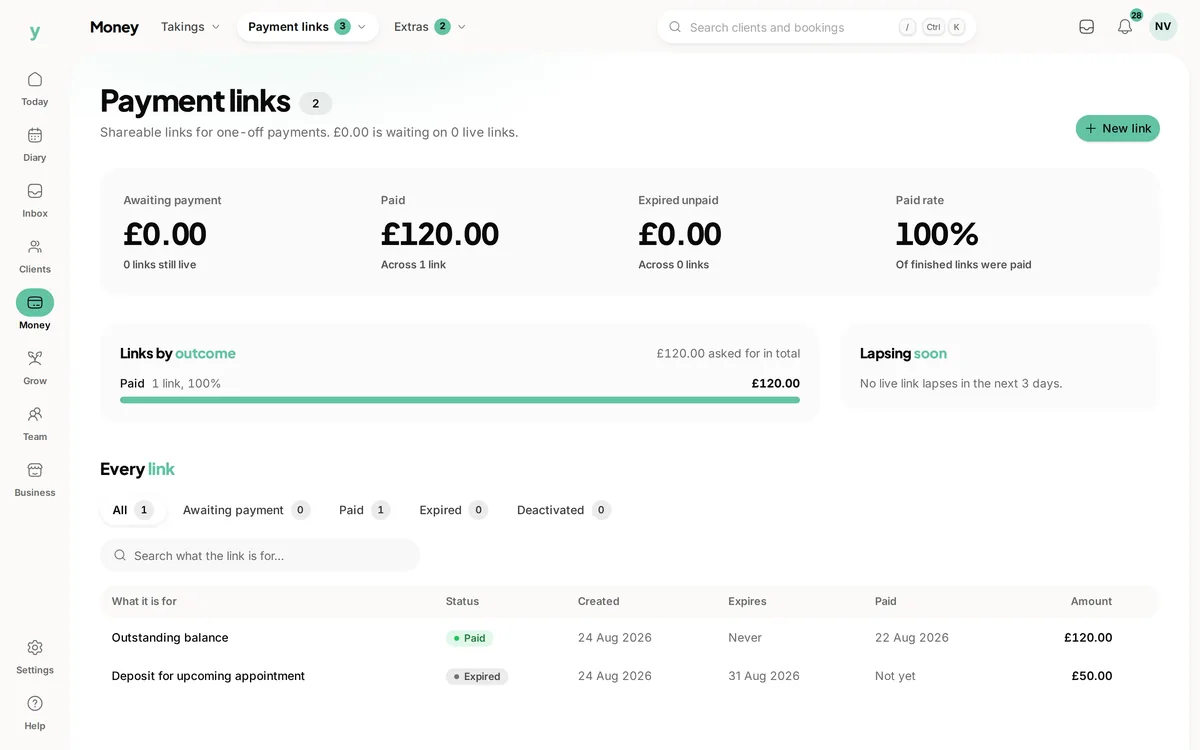
 A deposit, asked for by link
For anyone paying later
Send a link for a deposit or a balance, see what is still waiting and let the chasing run itself.
Take a deposit when the booking is made rather than hoping on the day, with the card rate at Stripe's own 1.5% plus 20p and nothing added by Youzse.
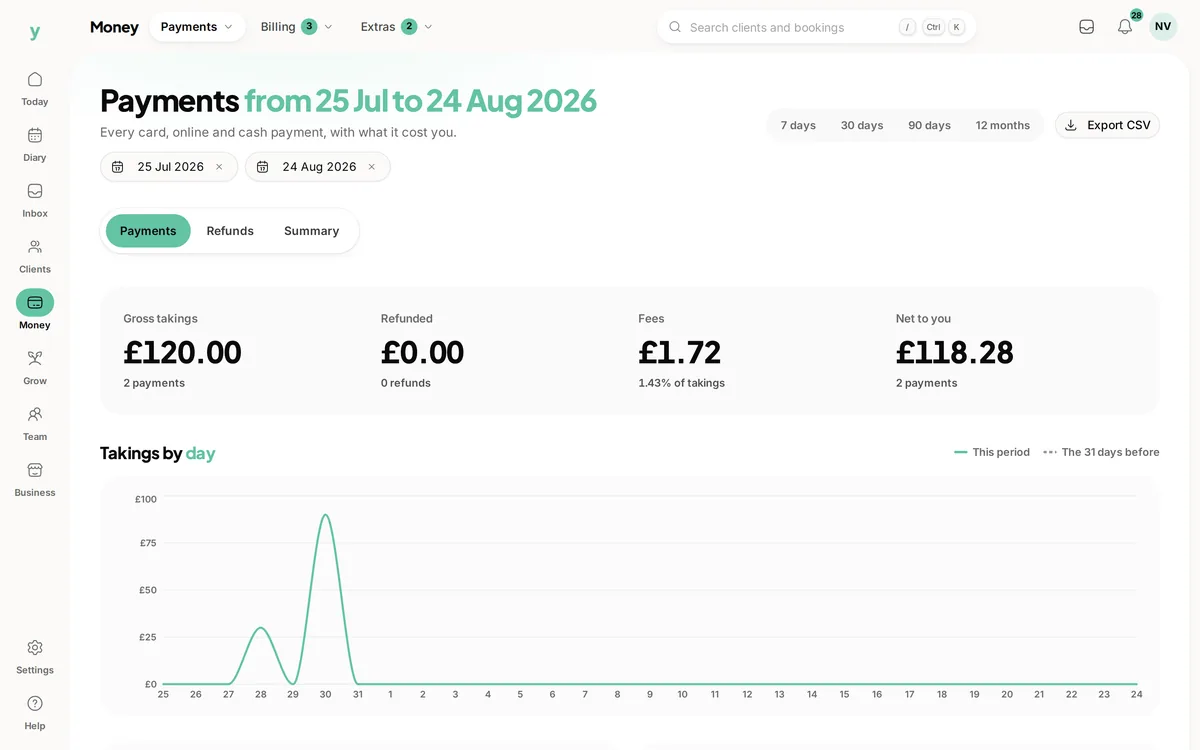
Real screens from The Cutting Room, our demo salon, with the numbers it shows today.
A deposit, asked for by linkSend a link for a deposit or a balance, see what is still waiting and let the chasing run itself.
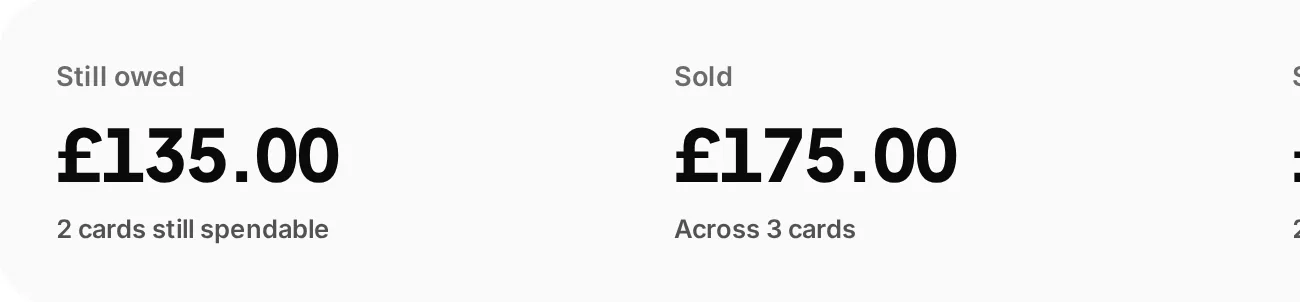
Gift cards, memberships and a balance carried from last time all land on the same appointment, so checkout is not arithmetic.
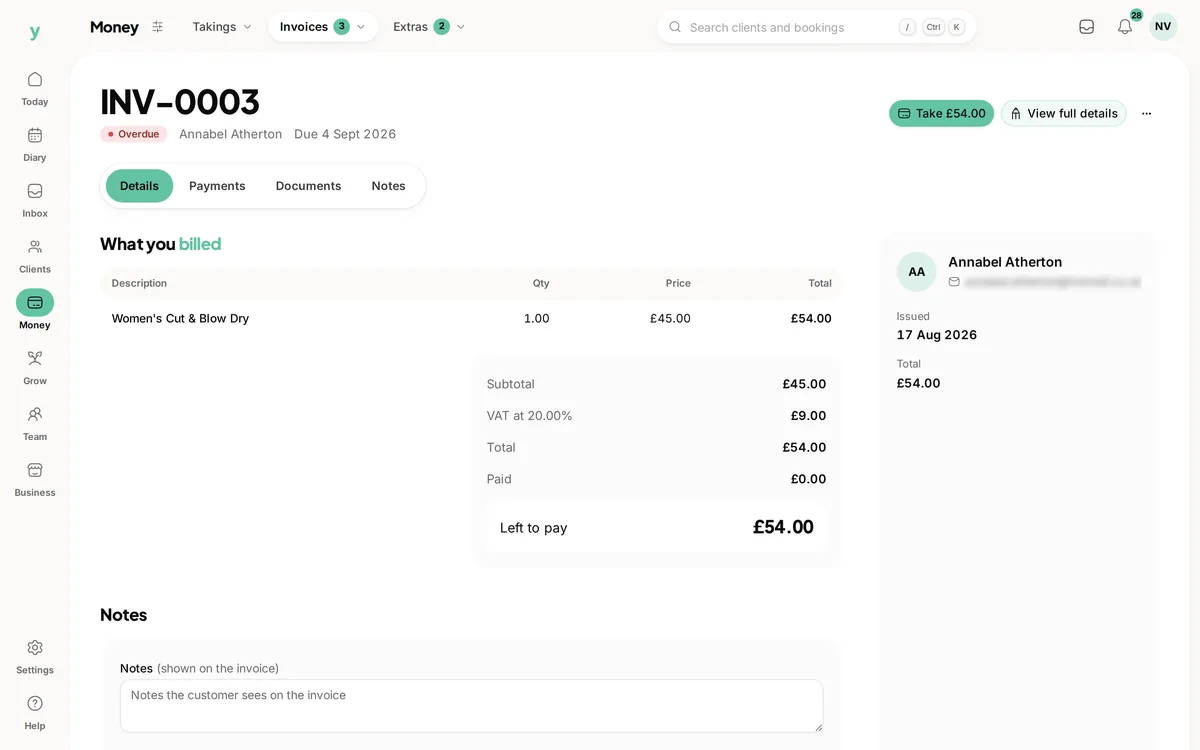 Take the payment from here
What has been paid and what is still due are tracked apart, so a deposit and a final balance sit on one invoice.
An unpaid booking costs the customer nothing to abandon. That is the whole of the no-show problem in one sentence, and it is why the single most effective change most service businesses can make is to take some money at the point of booking. This page covers what Youzse can take, when it takes it, what the card payment actually costs and what you need in place before any of it works.
A deposit is set on the service, as either a fixed amount or a percentage of the price. A £20 deposit on a £95 colour, or 25% of whatever the service costs so the figure follows your prices when you raise them.
Setting it per service rather than per business is the point. A free consultation needs nothing. A four hour job that blocks a whole afternoon needs a commitment, and the same number on both would either scare off the enquiry or fail to protect the afternoon.
The deposit is taken when the booking is made, through the booking page, and it is held against the appointment. At checkout it comes off what is owed rather than sitting somewhere separate to be remembered, so the balance on the day is the price minus what has already been paid.
A deposit is money taken. A card on file is money not taken yet, kept so a fee can be charged if one becomes due. They solve different problems and it is worth being clear which one you want.
You can require a card at booking across the business, or let the services decide: a service that carries a deposit or a fee asks for a card, and one that carries neither does not. That rule is applied per basket rather than per business, so a free consultation booked from the same menu as a chargeable treatment is not forced through a card step it has no use for.
The rule is enforced on the server as well as in the booking page. That sounds like an implementation detail, and it is the difference between a policy and a suggestion: without it a crafted request can book straight past the card step into a service that carries a fee.
| How | When it suits | Worth knowing |
|---|---|---|
| Deposit at booking | Anything where a missed slot costs you the slot. | Fixed or a percentage, set per service. |
| Card saved at booking | Where you charge a fee rather than take money up front. | Required business-wide, or only for services that carry a fee. |
| Full payment at booking | Classes, courses and anything prepaid. | The same card step, for the whole price. |
| Tap to Pay on iPhone | On a driveway, in a van, at a chair with no till. | Works on iPhone and on Android. No reader to buy. |
| Payment link | Somebody who wants to pay later, or over the phone. | Sent to the customer, and chased automatically if it goes unused. |
| At checkout | The balance on the day. | Deposits already taken come off the total. |
Standard UK cards are 1.5% plus 20p. That is Stripe's own processing rate and Youzse adds nothing on top of it, which is the part worth checking against anybody else you are considering: a platform rate of "1.5% plus 20p" is a different number from a processing rate of 1.5% plus 20p with a platform margin behind it.
There is 0% commission on anything you take. That includes customers who found you through Youzse rather than through your own link, which is where marketplace platforms usually charge a new client fee.
Money goes to your own bank account, from your own Stripe account. Youzse does not hold your takings and does not pay them out to you on a schedule of its own.
A card kept on file is only useful if you are allowed to charge it, and "they ticked something once" is not a position you want to defend. The consent is recorded explicitly, in words the customer read, with the version of the wording and the time they agreed.
A customer can give that permission for one business or for every business that books them in through Youzse, and they can withdraw it from their own account at any time without going through you. Every charge produces a receipt.
That is more friction than quietly keeping a card, and it is the right amount. A fee charged against recorded consent is a fee you can stand behind. A fee charged against an assumption is a chargeback with your name on it.
A deposit can be refunded, in full or in part, and the refund goes back the way it came. What is worth deciding before you take your first one is what your policy says about a cancellation, because the software will do what you tell it and your customers will read what you published.
Keeping a deposit on a late cancellation counts towards the same limit as a late cancellation fee. You cannot keep a deposit and also charge the fee in full: the two together are held to the cap, which is covered on the fees page.
Outside your cancellation window, a deposit normally goes back and the slot goes back on sale. That is the bargain the window exists to make, and it is why a window set honestly earns you more than one set to catch people.
A deposit is not the only thing that comes off a bill, and a system that handles one but not the others leaves you doing arithmetic at the till.
A gift card can be redeemed against the booking. A membership the customer holds can discount the service automatically, at the best rate they qualify for rather than the first one found. An outstanding balance from a previous visit is tracked rather than forgotten, and a tip is recorded as a tip rather than being folded into the service price where it will distort your reporting later.
All of that lands on the same appointment, so the figure you ask for at checkout is the price, less what has been paid, less what has been discounted, with nothing held in somebody's head.
On a £50 service paid by card, 1.5% plus 20p is 95p. On a £20 deposit it is 50p. There is no fee per booking on top of that and no commission on the value of the appointment, whether the customer came from your own link or from Youzse.
Plans start at £19 a month. The trial is 30 days and takes no card, so you can connect Stripe, take a real deposit and refund it before you decide anything.
If you want the comparison rather than the mechanics, the cost calculator runs the sum on your own card takings and your own number of new clients a month.
How much to ask for and how to tell customers, before you set a number.
The options a UK service business actually has, and what each one costs.
What the saved card is for, and the caps on what may be charged.
Run the sum on your own card takings rather than a worked example.
The limits and the detail, answered before you spend an afternoon testing for them.
Yes, and you should. A deposit is set on the service, as either a fixed amount or a percentage of the price, so a free consultation can take nothing while a four hour job asks for a commitment. One figure across the whole business either deters the enquiry or fails to protect the afternoon.
We value your privacy
Cookies keep Youzse running, improve the platform and help deliver relevant content. Read our privacy policy and cookie policy.