
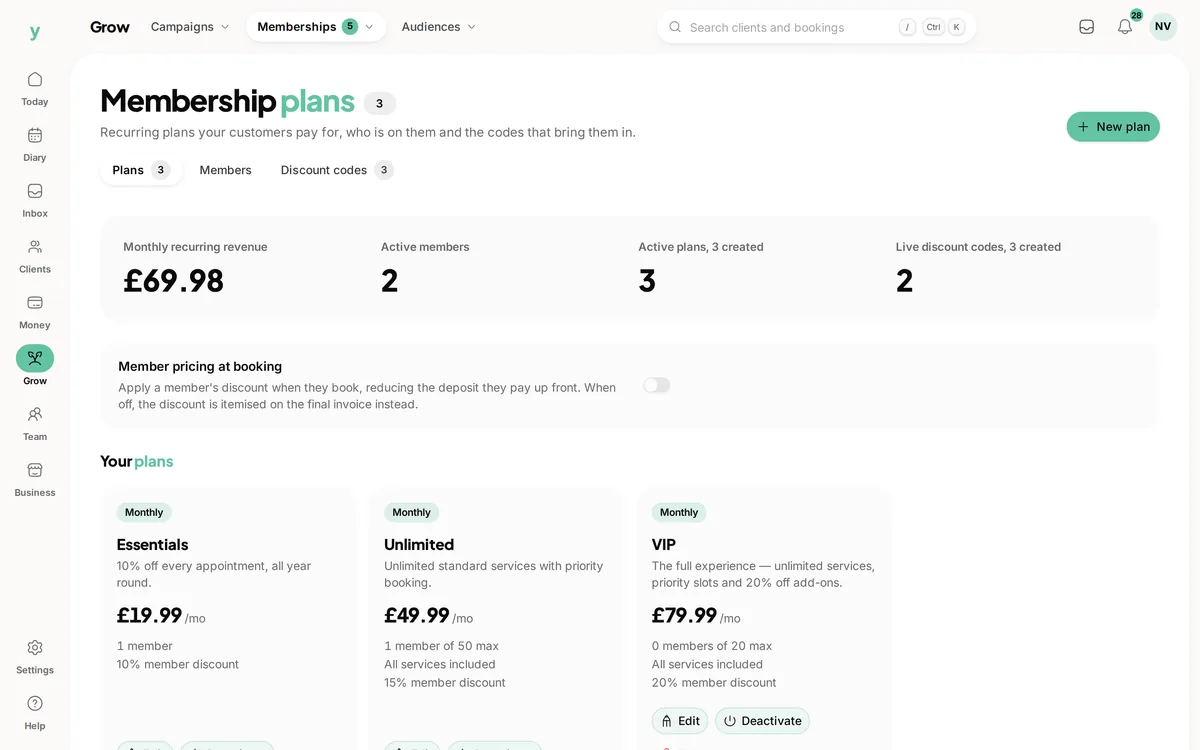
 3plans on sale
Memberships alongside passes
A block of classes is money now with no commitment. A membership is less now and a better January. Most studios sell both.
Sell ten classes for a price, let the credits come off as people book and stop keeping the tally in a notebook that is always one class out of date.

Real screens from The Cutting Room, our demo salon, with the numbers it shows today.
3plans on saleA block of classes is money now with no commitment. A membership is less now and a better January. Most studios sell both.
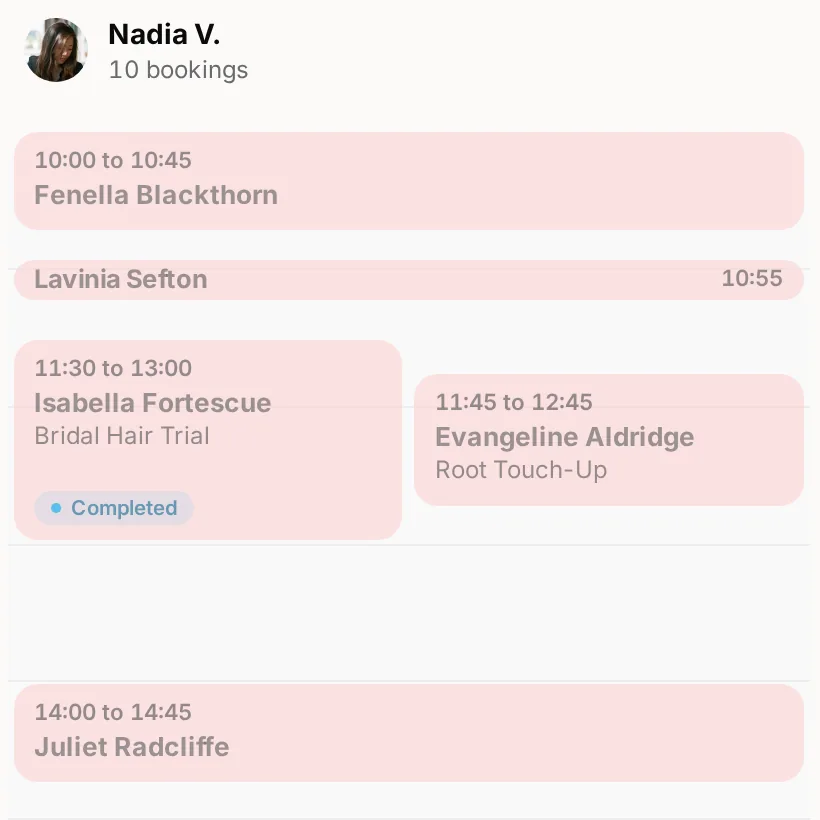
A private session and a class occupy the same diary, which is what stops a studio booking two things into one room.
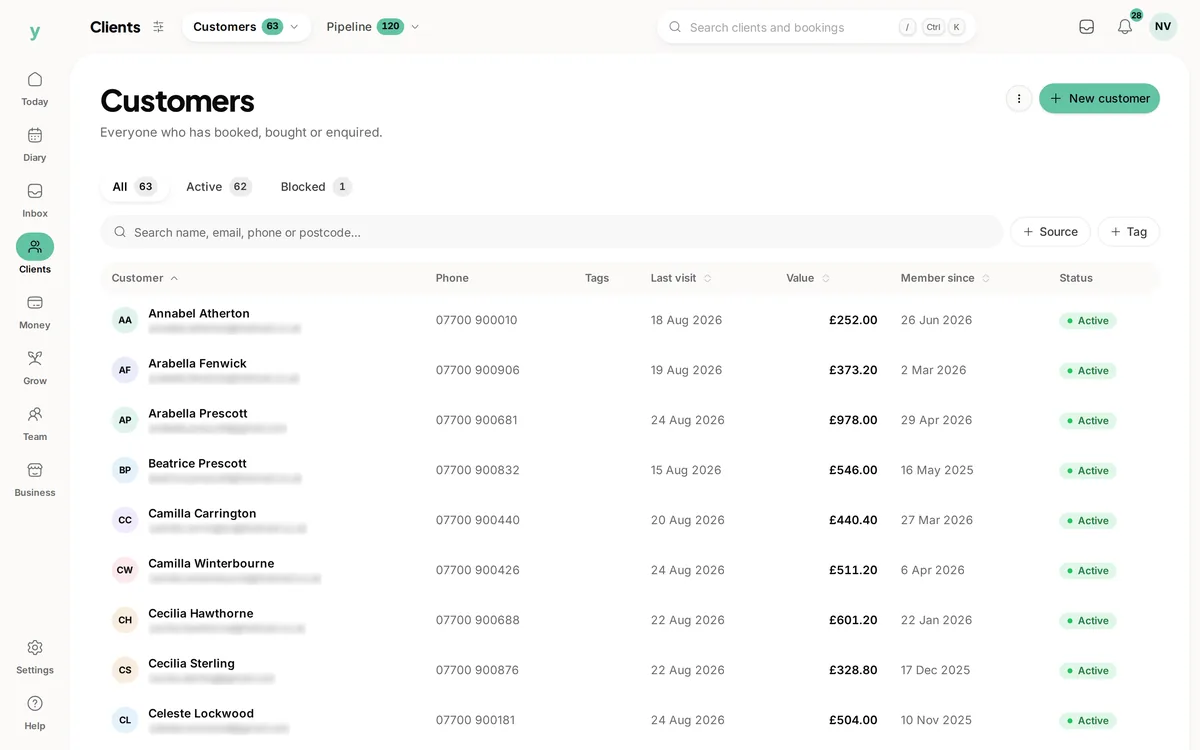 Last visit, value and status
Credits sit on the customer rather than in a notebook, so the balance you quote is the balance they have.
Studios do not sell single classes, not really. They sell blocks: ten for £80, a term, a card somebody bought in March and is still working through. The software problem is not taking the booking, it is knowing what everybody has left without keeping a second set of books. This page covers how packages work in Youzse, what happens when two bookings go for the same last credit and the one thing a package is not.
A package is what you sell: a name, a number of classes, a price and how long it stays valid. Ten classes, £80, ninety days. You set them up once and they sit on the list.
A pass is what a customer holds after buying one. It knows how many classes are left, when it expires and what it was bought for.
Keeping them apart is what lets you change your prices without rewriting history. A pass takes a copy of the name, the number of classes, the price paid and any service restriction at the moment it is sold, so raising the price of a ten class block next month does not reach back into what somebody already bought.
A booking against a pass takes one credit off the balance. A cancellation that should return it puts it back. Both of you can see what is left, which removes the conversation that starts "I think I have three left" and ends with you agreeing to whatever they say.
The balance cannot go below zero, and that is enforced where it matters rather than where it is easy. Two bookings arriving at the same instant for the last credit are serialised against the pass itself, so one of them gets it and the other is told there is nothing left. A tally held in a spreadsheet or checked before the write rather than during it goes negative in exactly this situation, usually on the busiest evening of the week.
Where a package is sold for money, the sale is recorded as a payment, so the £80 appears in your takings on the day it was sold rather than being invisible until the classes are used.
| Setting | What it does |
|---|---|
| Name | What the customer sees. "Ten class card", "Autumn block". |
| Classes included | How many credits the pass starts with. |
| Price | What it costs. Zero is allowed, for a comped or trial pass. |
| Valid for | How many days from purchase until it expires. Always set, so no pass is open ended. |
| Restricted to a service | Optional. A reformer block that cannot be spent on a mat class. |
| Active | Whether it is still on sale. Retiring a package does not touch the passes already out there. |
An expiry is not optional, and that is on purpose. An open ended pass is a liability that sits on your books indefinitely and turns up two years later asking to be honoured.
A drop-in timetable and a six week course look similar on a price list and behave completely differently once somebody has paid.
Youzse sells courses the way it sells everything else: you publish the dates as a repeating timetable and sell a package for the number of sessions. The money comes in up front, the register is right and each date is booked against the balance. What you do not get is a single enrolment that silently fills all six dates. A learner who never books week four shows as an unused credit rather than as an absence.
For most studios that is the better behaviour, because an unused credit is visible and a no-show against a pre-filled booking is not. If you run closed cohorts where one purchase must book every week without the learner touching it, test exactly that before you commit to any system, this one included.
A package is a fixed number of classes bought once. A membership is a recurring arrangement, and some studios want both: a ten class card for the person who comes when they can and a monthly membership for the person who comes every week.
A membership can discount the services it covers automatically, at the best rate the customer qualifies for rather than the first one found, so somebody holding more than one is never quietly charged more than they should be.
Which to lead with is a business decision rather than a software one. A package is money now and no commitment; a membership is less money now and a better January. Most studios that get this right sell both and let the customer choose.
A pass is only half of it. The session it is spent on carries its own settings, and they are where most of a studio's actual rules live.
A capacity, which is enforced rather than advisory. A minimum number for the class to run, so you know on Thursday afternoon whether Friday morning is going ahead. A price and, if you want one, a deposit rather than the full amount. A refund window. Whether a waitlist is open on it at all.
Those are per session rather than per service, so a Saturday workshop with eight places and a different refund rule does not need its own service set up alongside the weekly class it looks like.
Rebuilding a week by hand every term is the single biggest time sink studio owners describe, and it is the thing to test rather than take on trust.
A class can run as a repeating series on a recurrence rule, with a start, an end or a number of occurrences, and with specific dates excluded. The bank holiday Monday you do not teach is an exclusion on the series rather than eleven individual cancellations.
The series keeps its own timezone, which sounds like a technicality until the clocks change. A weekly nine o'clock class should still be at nine in March, and a timetable stored without a timezone will quietly move it.
Classes, repeating series, packages and one to one appointments all sit in the same diary. That is what stops a studio booking a private session into a room that has a class in it, which is the failure that eventually happens to every studio running two systems.
There is no charge per pass sold and no cut of it. Youzse takes 0% commission on what you take, and a package paid by card is Stripe's own 1.5% plus 20p on standard UK cards with nothing added.
Classes, class packages, recurring timetables and one to one appointments all share one diary, which is the part that stops a studio double booking its own room. Plans start at £19 a month.
The trial is 30 days with no card, long enough to sell a block and run a few weeks of a timetable against it.
Capacity, waitlists and the difference between a class and a course.
What happens to the place somebody gives back the night before.
A timetable, blocks of classes and one to one sessions in one diary.
Hard capacity on the machines, and passes that draw down on attendance.
The limits and the detail, answered before you spend an afternoon testing for them.
You set up a package with ten classes, a price and a validity in days. A customer buys it and holds a pass. Each booking takes one credit off and a cancellation that should return it puts it back, and both of you can see the balance, so nobody has to remember.
We value your privacy
Cookies keep Youzse running, improve the platform and help deliver relevant content. Read our privacy policy and cookie policy.