
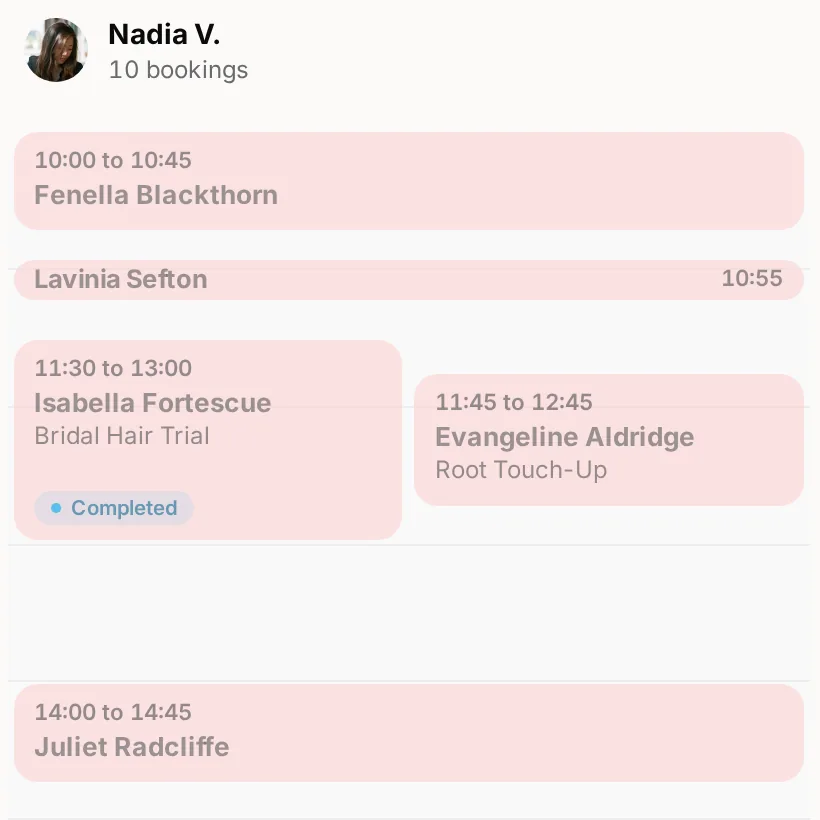
What a no-show actually costs
The hour is paid for in rent and wages whether somebody sits in it or not. That is the figure a fee is weighed against.
A fee you can actually charge, because the card was taken at booking and the policy was published before the appointment rather than argued about after it.
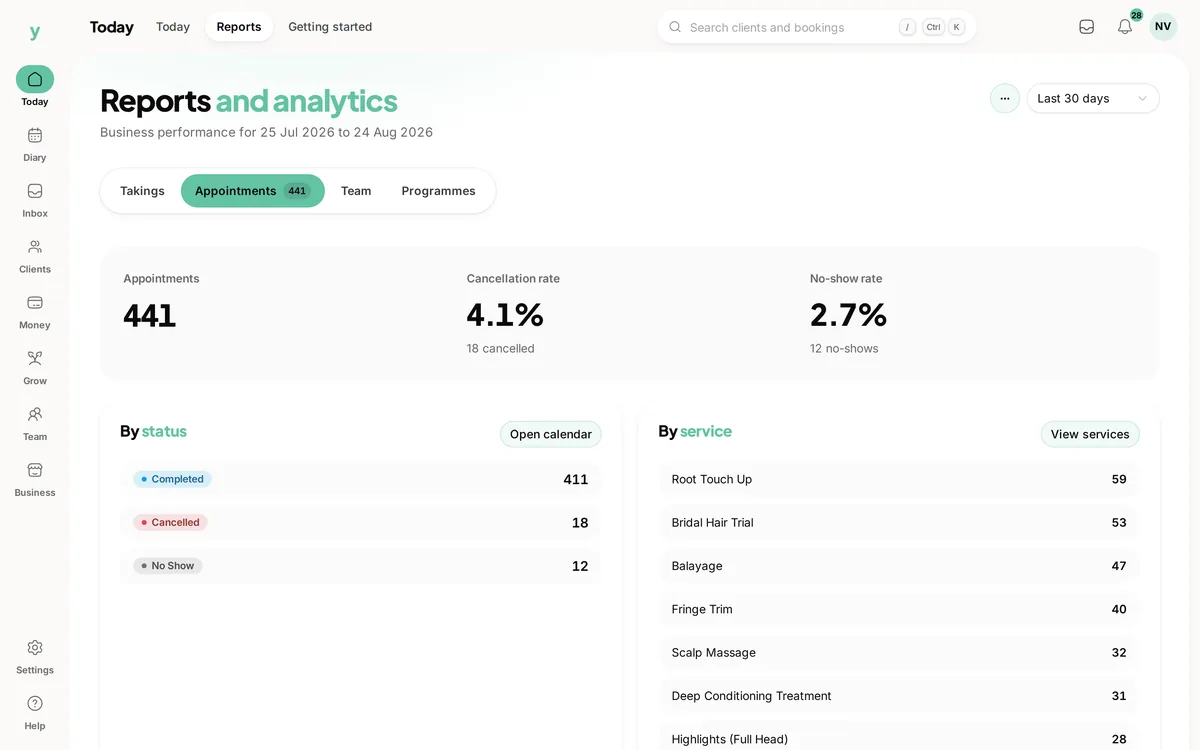
Real screens from The Cutting Room, our demo salon, with the numbers it shows today.
The hour is paid for in rent and wages whether somebody sits in it or not. That is the figure a fee is weighed against.
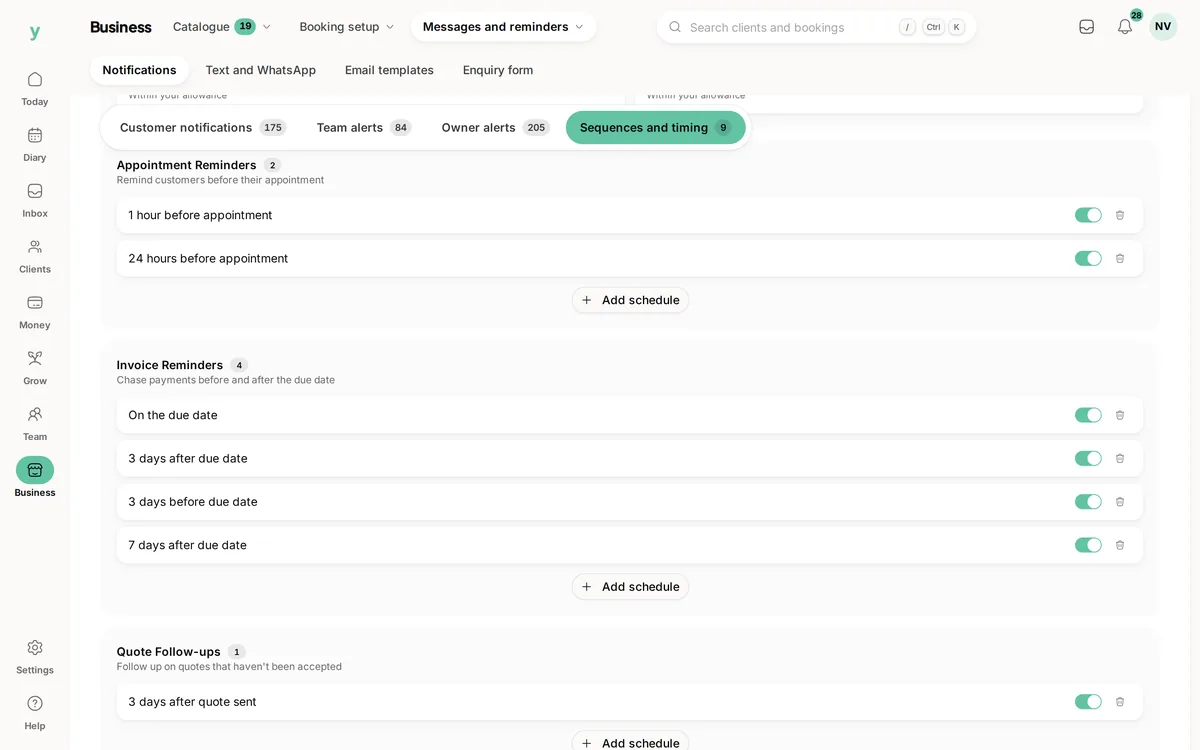 1 hour and 24 hours before
The policy is on the booking page, in the confirmation and in every reminder, which is what makes a fee defensible.
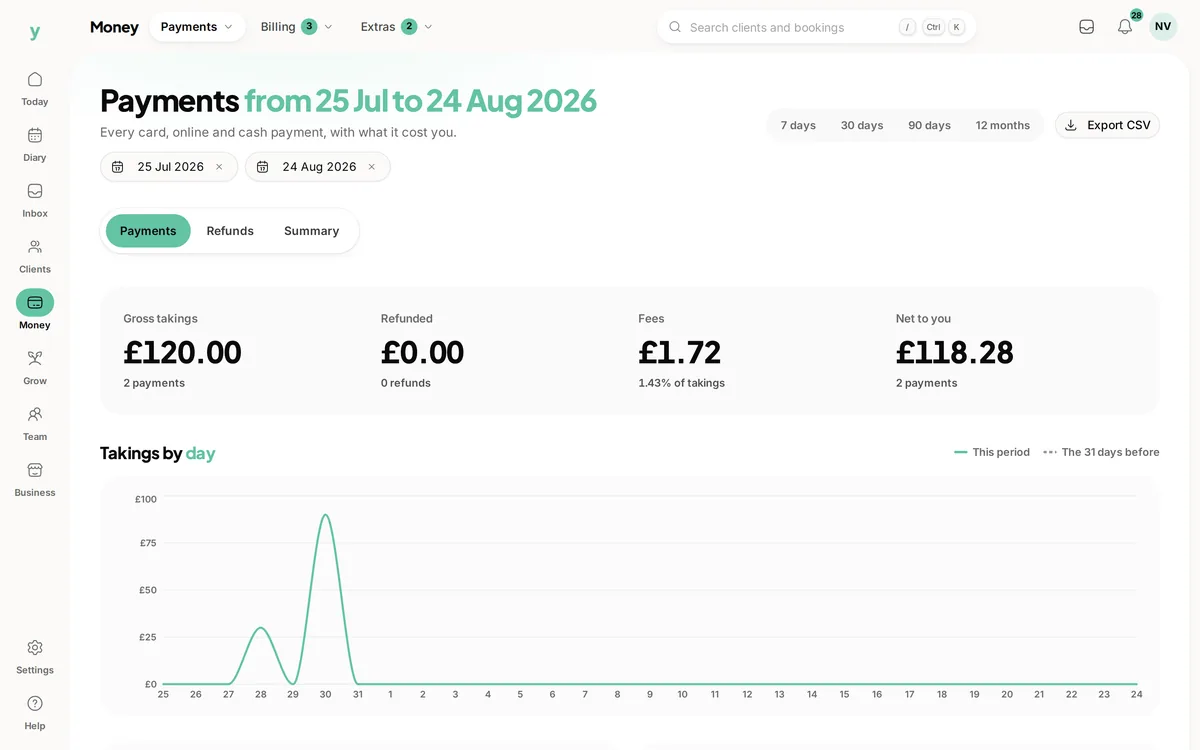 Stripe’s fee, nothing added
A fee goes through the same card rate as everything else, 1.5% plus 20p on standard UK cards, with no cut taken by Youzse.
A no-show policy nobody can enforce is a sentence on a website. Two things make the difference between a policy and a fee: the card has to already be there, and the amount has to be defensible. Youzse does both, and it holds you to limits on the second one even when you have configured something higher. This page explains the mechanics, the caps and the places fees are switched off entirely.
A no-show fee is for somebody who did not come and did not tell you. A late cancellation fee is for somebody who told you, but too late for the slot to be sold again. They are set separately because they are not the same behaviour and most businesses do not want to treat them the same.
Each one can be a fixed amount or a percentage, set on a service or across the business. A service can also be exempted from the business default entirely, which is what you want for the consultation that is free and the appointment you would never charge for.
The amount is written onto the booking when the booking is made. That is deliberate: a customer who booked under a £15 fee is not charged £30 because you changed your prices in the meantime.
Pick a number of hours before the appointment inside which a cancellation counts as late. Publish it. Youzse carries it on the booking page, in the confirmation and on the booking the customer manages themselves.
The minimum window is 24 hours. You cannot set a two hour window and charge somebody for cancelling the evening before, which is the configuration that generates chargebacks and complaints rather than revenue.
A customer who cancels outside the window pays nothing and gives you back a sellable slot, which is the behaviour the window exists to encourage. Put that slot in front of the waitlist and the cancellation costs you nothing at all.
| Fee | Most that can be charged | Notes |
|---|---|---|
| No-show | The full price of the service booked | Half the price in Ireland, Australia, New Zealand and California. |
| Late cancellation | Half the price of the service booked | And never more than the no-show fee on the same booking. |
| Deposit kept | Counts towards the same limit | Keeping a deposit and charging a fee cannot together exceed the cap. |
| Cancellation window | At least 24 hours | A shorter window cannot be set. |
The cap is applied against the price of the service actually booked, at the moment the fee is worked out and again when it is charged. A figure configured above the cap is reduced rather than refused, so the fee still goes through at the most it is allowed to be.
The settings screen will not let you save a fee above the cap. That is not enough on its own, for three reasons worth knowing if you are evaluating this properly.
A fixed fee is checked against your dearest service when you save it, so the same fee on a cheap service could still be over the line. A booking carries its own snapshot of the fee, so a fee saved before the caps existed travels with old appointments. And the cap itself depends on where the appointment takes place, which the settings screen cannot know for every location at once.
So the amount is clamped again, against the price of the service that was actually booked, at the point it is charged. The effect is that an overcharge is not possible even through a path nobody anticipated.
The caps tell you what you may charge. They do not tell you what you should, and the two are rarely the same.
A percentage is usually the better choice, because it follows your price list rather than needing revisiting every time you put your prices up, and because it stays proportionate across a menu where the cheapest and the dearest service are an order of magnitude apart. A fixed amount reads more clearly to a customer and is easier to say out loud, which matters on the phone.
Most businesses find that the fee they actually charge matters less than the fee being known about. A moderate fee, published and occasionally charged, changes behaviour more than a punitive one that you waive every time because charging it feels unreasonable. A fee you will not actually charge is worse than no fee, because your customers work out which it is within a month.
Start lower than you think, watch your miss rate for a month, and raise it if nothing changes. Youzse keeps the fee that applied when each booking was made, so raising it later does not reach back into bookings taken under the old number.
A fee nobody was told about is not a policy, it is a surprise, and surprises come back as disputes. So the fee and the window are on the booking page before the booking is made, in the confirmation afterwards and on the booking the customer can open from any reminder.
That repetition is the point. By the time somebody decides not to turn up, they have been told three times what happens if they do not, which is the difference between a fee you can charge and a fee you can argue about.
The same applies to a card. A customer asked for a card at booking is told what it is for at that moment rather than discovering it a fortnight later.
When a fee is charged, what existed beforehand matters more than the charge itself: the policy as published, the fee as it stood when the booking was made, the reminders that were sent and when, and the cancellation or the no-show being marked.
All of that is kept against the booking rather than reconstructed afterwards. If a customer queries a charge, or their bank does, the answer is a sequence of dated facts rather than your recollection.
It is also the reason the fee amount is snapshotted at booking rather than read live. A charge you can explain has to be the charge the customer agreed to, not the one your current settings would produce.
There is no charge for the feature and no cut of a fee you charge. Youzse takes 0% commission, and a fee charged to a card is Stripe's own 1.5% plus 20p on standard UK cards with nothing added.
The honest version of the benefit is not the fees you collect. It is the no-shows that stop happening once customers know a card is attached and a window is published, which is a number you will only see in your own diary.
The no-show calculator will put a figure on what missed appointments cost you now, using your own prices and your own miss rate, before you decide whether any of this is worth setting up.
The wording that makes a fee defensible rather than arguable.
What missed appointments cost you a year, on your own prices and miss rate.
The card that has to be there before a fee is anything but a sentence.
The mechanics that stop the behaviour rather than charging for it.
The limits and the detail, answered before you spend an afternoon testing for them.
Up to the full price of the service booked in the UK, and up to half of it in Ireland, Australia, New Zealand and California. Any deposit you keep counts towards the same limit. If you configure more than that, the amount is reduced to the cap when it is charged rather than failing.
We value your privacy
Cookies keep Youzse running, improve the platform and help deliver relevant content. Read our privacy policy and cookie policy.