
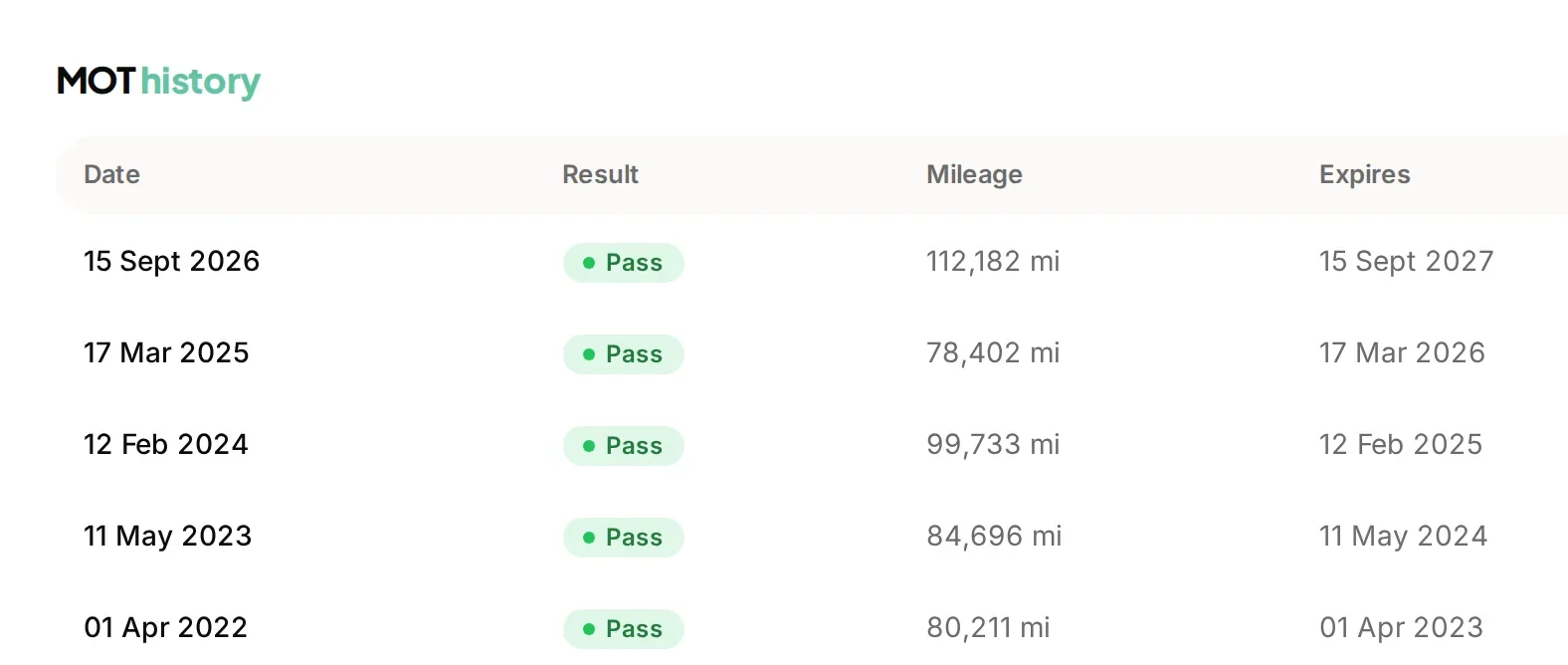
 Mileage and expiry for every test
History that outlives the owner
The record belongs to the vehicle, so a car that changes hands keeps its tests and stays on the reminder list.
Type a registration, get the car. The MOT due date comes with it, and the reminders run off that date without anybody keeping a list.
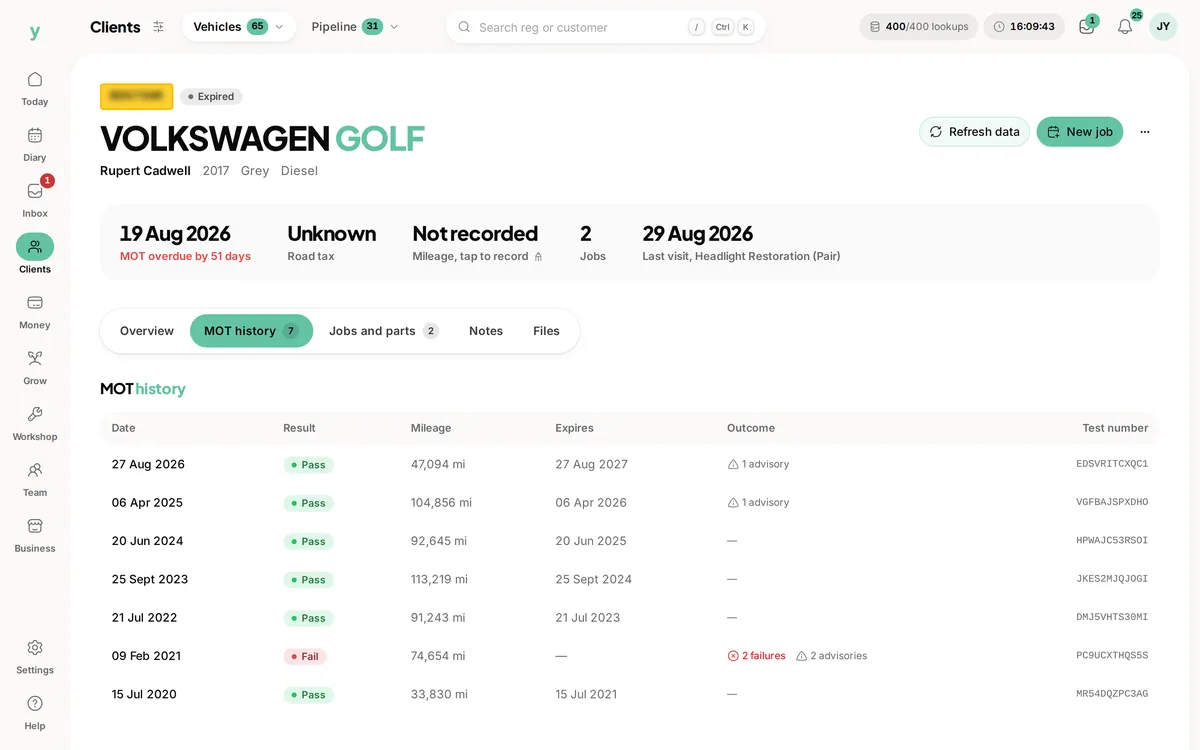
Real screens from Motorworks Garage, our demo garage, with the numbers it shows today. Number plates are blurred.
Mileage and expiry for every testThe record belongs to the vehicle, so a car that changes hands keeps its tests and stays on the reminder list.
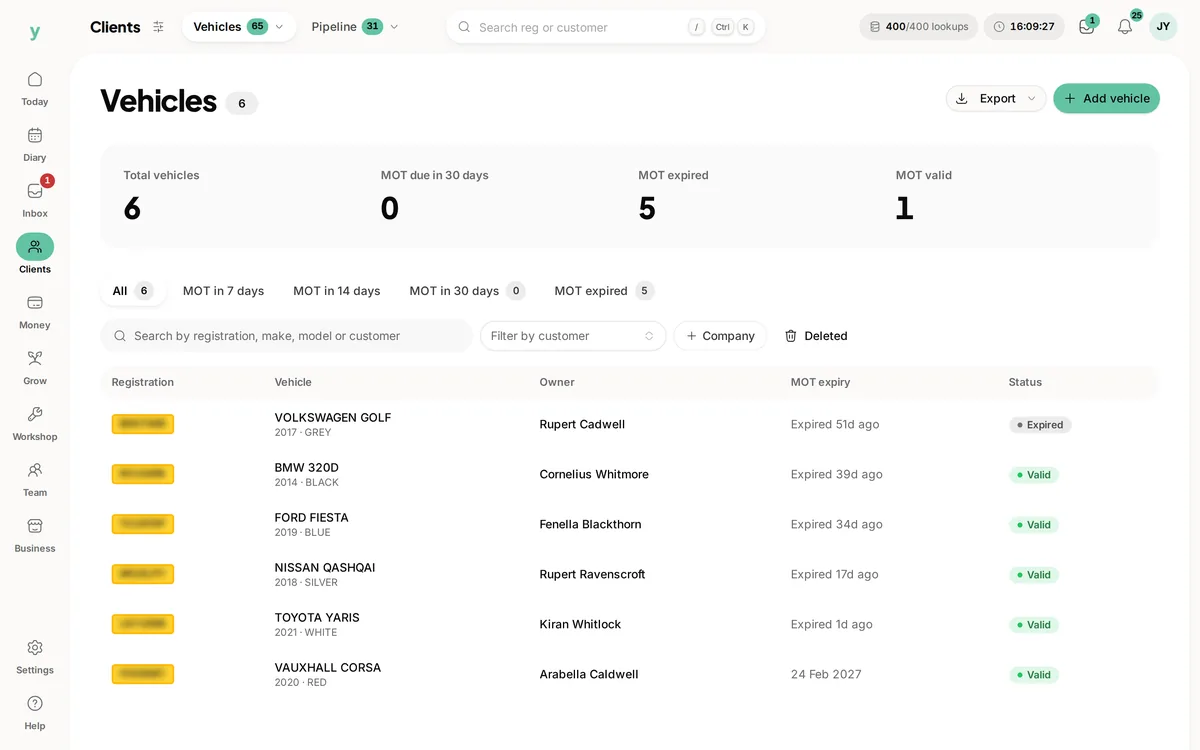 Each with its owner and MOT status
Every car you have seen, with the date its next test is due. That list is the work you already have.
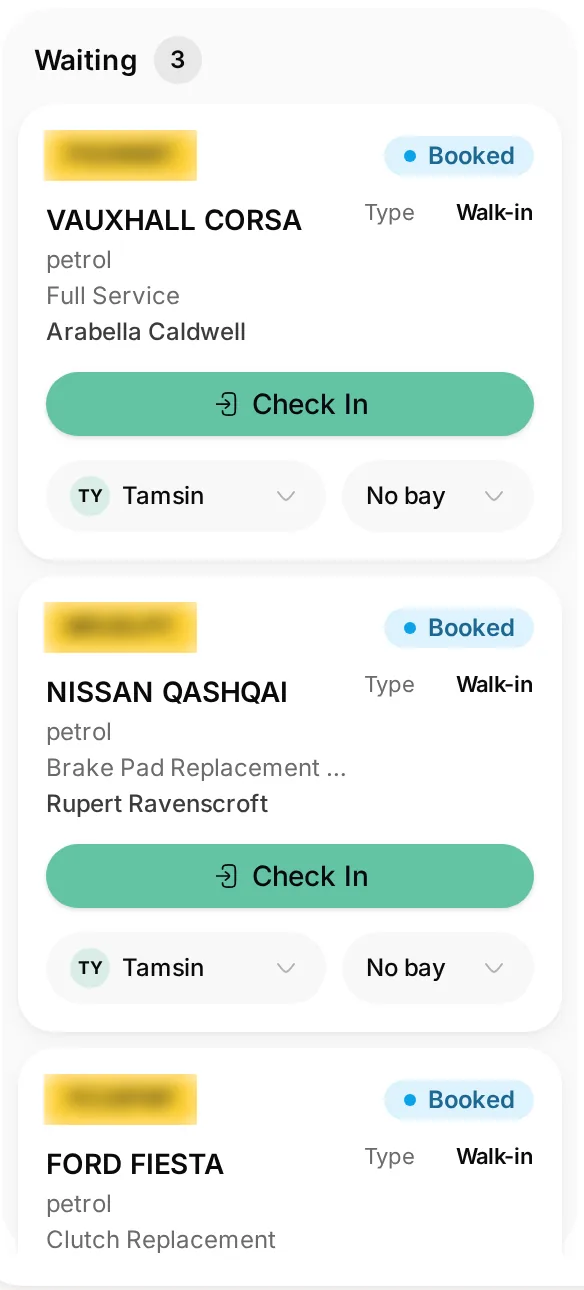 Check cars in from the board
A reminder that turns into a booking lands on the job board with its mechanic and bay, ready for the keys.
A garage's customer list is really a vehicle list, and the single most valuable thing on it is an MOT due date. A car with a date eleven months out is work you already have, if somebody remembers to ask for it. This page covers what Youzse can pull from a registration, where the reminders fire, what the lookups cost and the two conditions under which none of this is available to you at all.
Type the registration and you get the make, the model, the colour, the year, the fuel type, the MOT status and expiry and the tax due date, from the DVSA MOT history service. The vehicle goes on the record against the customer rather than being typed in twice.
A registration your garage already holds does not go out to the API at all, because the car is already on your books. One that does is kept for a week, and a plate that does not resolve is remembered for an hour so a typo does not keep costing lookups.
If the service is slow or rate limiting, lookups stop for a few minutes rather than hammering it. You get a form you can type into instead of a page that hangs, which is the behaviour you want on a Monday morning with a queue at the desk.
The MOT expiry is a date in the future that nobody has to maintain. The reminders run off it.
You choose the lead time, anywhere from a week to three months, and thirty days is the default because that is when most people start thinking about it. Follow-ups trail behind it at a fortnight, a week and the day itself, and any that fall on or after your chosen lead time are dropped so the sequence always counts down rather than doubling up.
After the expiry there are further notices, the day after and then at a week and a fortnight, for the car that did not come back. That is the part most garages never get round to doing by hand and it is where the recovered work is.
Every reminder carries a link to book, so the customer can take a slot rather than ringing during the one hour you are not under a car.
| When | What goes out |
|---|---|
| Your lead time, 7 to 90 days before | The first reminder. Thirty days unless you change it. |
| 14 days before | A follow-up, if your lead time is longer than that. |
| 7 days before | A follow-up, if your lead time is longer than that. |
| The expiry date | The last reminder before it runs out. |
| The day after | A notice that it has expired. |
| 7 and 14 days after | Two further notices for a car that has not come back. |
A business with MOT reminders switched off is skipped entirely, and the whole sequence is per vehicle rather than per customer, so a two car household gets two sets of dates rather than one muddled one.
A VIN lookup is a different thing from an MOT lookup and comes from a different, paid source. It is counted per month against your plan: fifty on the entry garage plan, a hundred and fifty on the middle one and four hundred on the largest, with top-ups if you need more.
When the allowance is gone the lookup returns nothing rather than failing the job. The rest of the vehicle record carries on working, and you type what you need.
MOT history lookups are not metered the same way. The distinction matters if VIN data is central to how you order parts, so check your own volume against the allowance rather than assuming.
A garage that keeps its history against the customer loses it the moment a car changes hands, and a car that changes hands is a customer you could have kept.
History sits against the vehicle: the MOT history pulled from the government service, the work you have done, the mileage, the next service due. The customer is attached to the vehicle rather than the other way round.
That is also what makes a second reminder type possible. A service due date is a date you set rather than one the government holds, and a car with one coming up inside a fortnight gets a notice, with the same vehicle suppressed for a month afterwards so a fortnight of sweeps does not become a fortnight of messages.
The lookups are the start of a job rather than the whole of it. On the workshop side the same vehicle record carries the job card, the vehicle health check, the parts the job needs and the bay it is in.
That matters for a reason specific to garages: a health check that found something you did not do today is next month's work, and it is only next month's work if it is written against the car rather than mentioned to the customer in the doorway.
The workshop side is its own plan feature and, unlike the vehicle data, it is not tied to the United Kingdom. Job cards, health checks, parts and bays are a way of running a workshop and they work the same anywhere. It is only the DVLA and DVSA lookups that stop at the border.
None of this does anything on day one, because a reminder needs a vehicle and a vehicle needs to be on the system. A garage with eight hundred customers in a spreadsheet and a wall planner is the normal starting point, not the exception.
Two routes in. Existing records can be imported from a CSV at setup, which is the right move for a list you already keep, and an import can be undone if the columns come out wrong rather than leaving you to unpick it row by row. Everything after that arrives through the lookup: a plate typed at the desk puts the car, its MOT history and its expiry on the record in one step, so the list builds itself as cars come through.
The second route is slower and more accurate, and it is worth being realistic about the first month. A garage that imports a list and then does nothing will send reminders against whatever dates the spreadsheet held. A garage that looks up each car as it arrives has a shorter list that is actually right, and inside a year it has the whole book.
Either way the thing that makes this compound is that the MOT date is maintained by somebody else. Once a car is on the record you are not keeping a date up to date, you are reading one.
The vehicle lookups, the MOT dates and the reminder sequence are part of a Garage Pro plan rather than a paid add-on, and there is no charge per reminder sent and no commission on the work that comes back.
Where a customer pays by card, standard UK cards are 1.5% plus 20p, all of it Stripe's own rate.
The trial is 30 days with no card. The MOT retention calculator will put a figure on the work you are currently not getting back, on the vehicles on your own books, before you set any of it up.
What to look for in a reminder system, and why August is the test.
The work already on your books, and how much of it you are not getting back.
Put a figure on the cars that never return, using your own numbers.
Job cards, vehicle history and payments around the same vehicle record.
The limits and the detail, answered before you spend an afternoon testing for them.
The make, model, colour, year and fuel type, plus the MOT status, the MOT expiry and the tax due date from the DVSA MOT history service. The vehicle goes on the record against the customer rather than being typed in by hand.
We value your privacy
Cookies keep Youzse running, improve the platform and help deliver relevant content. Read our privacy policy and cookie policy.